Apartment dance workouts: quiet, small-space, neighbor-proof
You can absolutely dance-workout in an apartment — what you can't do is jump in one, and the good news is you don't need to. Floor noise comes almost entirely from landings, not from movement. Keep your feet low, put a rug under your dance zone, pick civilised hours, and a real cardio session becomes about as loud to the flat below as walking around your kitchen. Here's the honest physics, the space math, and the anxiety part nobody talks about.
What your neighbors actually hear
Building sound comes in two kinds, and they behave completely differently. Airborne sound — music, your voice — weakens fast through walls and floors; at living-room volume it's rarely the problem. Impact sound — jumps, stomps, dropped weights — is different: the thud enters the building's structure and travels along it, re-emerging as sound in the ceiling below. That's why a jumping jack bothers the neighbor while a much “louder” podcast doesn't.
How much survives the trip depends on the building — thick concrete slabs swallow most of it, older wooden floors broadcast it — which is why one person dances for years without a complaint and another gets a broom on the ceiling in week one. You can't choose your slab. You can choose your landings.
Keeping the choreography, losing the thuds
- Ground the jumps. Nearly every airborne move has a grounded twin: step-touch instead of a hop, a quick low step pattern instead of a leap, rising onto the balls of your feet instead of leaving the floor. The cardio survives; the impact doesn't.
- Land heel-to-toe, not flat. When a move does come down, rolling through the foot spreads the force over time — a soft landing is quieter downstairs than a flat one by a wide margin.
- Rug under the dance zone. A dense rug or interlocking mats cushions impact at the source — the one purchase that genuinely helps, and it doesn't need to cover the room, just where your feet work.
- Dance in the daytime window. The same session reads differently at 2pm and 11pm. If your schedule forces the quiet hours, that's when strictly no-jump sessions matter most.
The floor-plan math for dancing
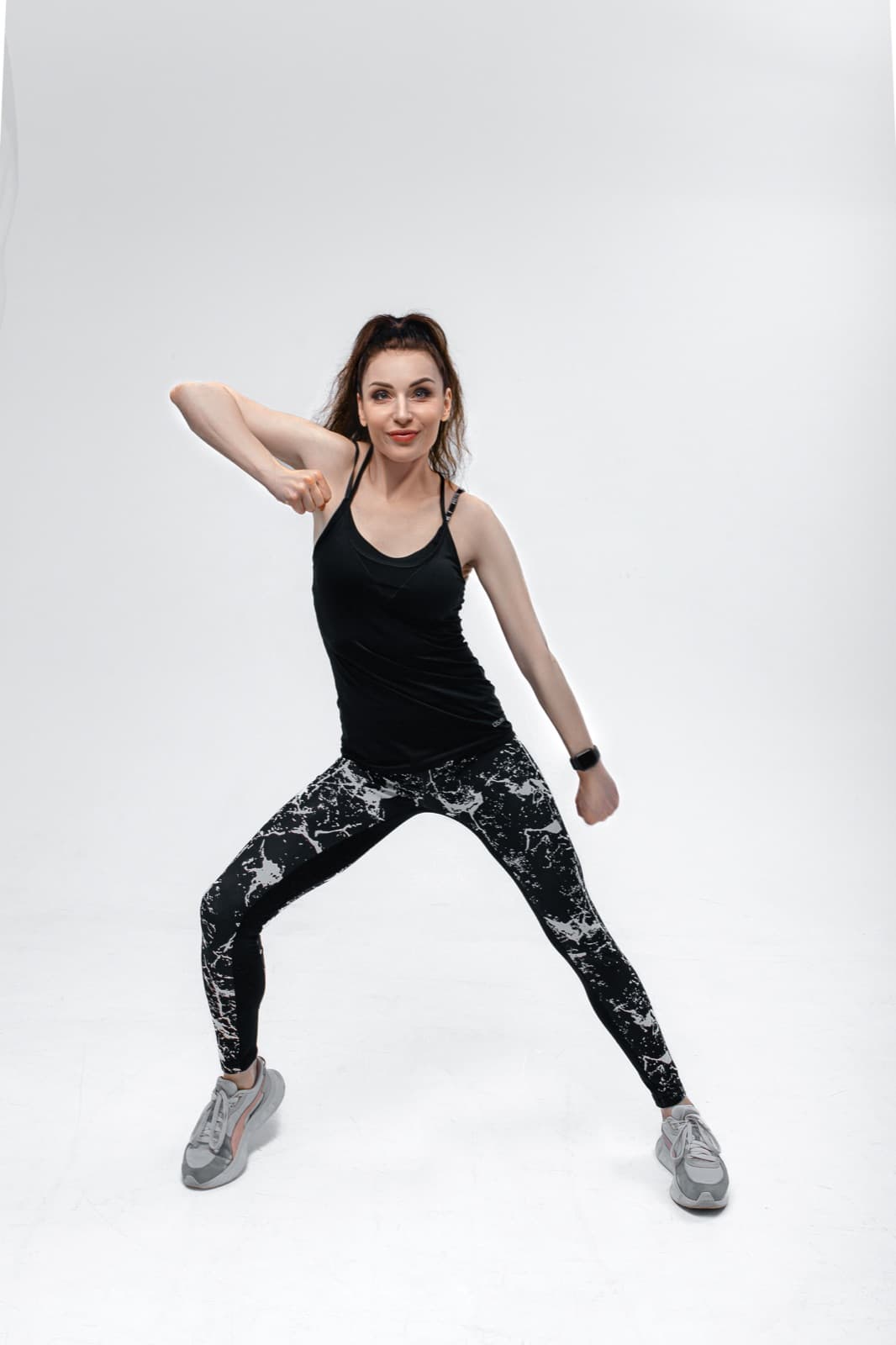
A dance session needs a movement footprint, not a room: enough space to take a full step in each direction and swing your arms without clipping a lamp — in practice, about two by two metres of clear floor. Add a quick spin check (arms out, turn once, touch nothing) and mind anything at head height. A coffee table pushed aside converts most living rooms; small-footprint choreography — the kind built from steps rather than travel — is designed for exactly this.
Is it really bothering them — or is it the anxiety talking?
Here's the part no workout article admits: many people tiptoe through home workouts not because anyone complained, but because they're pre-emptively embarrassed about existing audibly. Some proportion is worth keeping: a 20–30-minute step-based session during the day is ordinary living noise — the same category as vacuuming — not an imposition. If you're genuinely unsure, the fix is social, not acoustic: one short, friendly “let me know if you ever hear my workouts” conversation buys more peace of mind than any mat. Most neighbors, asked directly, haven't noticed a thing.
Check out the 21‑Day Dance Challenge
Short, beginner-friendly dance workouts you follow along at home, led by choreographer Anastasiia. The first session is free to watch — no sign-up, just press play and see how it feels.
See the ChallengeCommon questions
- Can I really do dance cardio in an apartment?
- Yes — step-based dance cardio with no jumps produces about as much floor noise as purposeful walking. The moves that cause complaints are landings: jumps, leaps, and heavy heel strikes. Keep both feet low, land heel-to-toe when a move does come down, and an apartment session is a non-event for the building.
- What's the quietest time to do a dance workout?
- Daytime and early evening, when the building's background noise masks footfall. There's no universal rule, but floors are most audible early morning and late night against a quiet building — if your only slot is 6am, that's exactly when step-only, no-jump sessions earn their keep.
- Do rugs or mats actually help the neighbors below?
- For thuds, yes. Impact noise travels through the structure of the building, and a dense rug or thick mat under your dance zone cushions the source before it reaches the floor. It does little for airborne sound like music — so soften the landings and keep the speaker at a reasonable level rather than relying on the rug for everything.
- Will my neighbors always hear something?
- Honestly: it depends on the building more than on you. A thick concrete slab swallows footsteps that a springy old wooden floor broadcasts. What you control is the impact you create — and a no-jump dance session creates very little. If you can walk around your flat without complaints, you can dance a step-based workout in it.
- My downstairs neighbor already complained — what's the cheapest fix?
- Three moves, in order: switch fully to no-jump sessions (the biggest win, free), put a dense rug or interlocking mats under the spot where you dance, and shift sessions toward daytime. Together they remove almost all of what travels downward. A short friendly conversation about which times work also does more than any equipment.